Showing posts with label Learning Disabilities. Show all posts

Wednesday, November 24, 2010

Learning Disabilities

I used to wonder what it felt like to have a learning disability since I knew many people who had them.
I found out.
When I was finally diagnosed with chronic Epstein-Barr disease I was given an anti- viral medication that caused severe side effects. I won't mention the name of the medicine because the manufacturer would probably sue me. One of the side effects was a learning disability. At least I guess that's what you'd call it, since I'd already finished school.
At first I couldn't read even a paragraph and remember how it had started. My reading skills had always been at the 99th percentile, but all I could read and understand were simple picture books. Over a period of months that improved and I could read normal material again, but only if there was no background noise or anything else to distract me.
And I couldn't remember numbers or do even the simplest arithmetic for months.
That happened about twenty years ago and my reading seems to be almost back to normal. Background noise only distracts me if I'm reading something that requires intense concentration like a scientific or legal document, and I rarely read those. I'd guess my reading level is now at about the 80th percentile, which is certainly adequate.
However I still have a problem remembering numbers and there have been times when I was under stress and couldn't think of my own phone number. Math was always the hardest subject for me in school and my levels on aptitude tests were usually below the 70th percentile. Now they're probably far below that and I'm thankful for calculators and the automatic dial feature on phones.
So now I know how it feels to have a learning disability. It doesn't feel like anything. Being unable to remember a number or something I had read a few seconds earlier felt no different than forgetting other things, and everyone forgets things at times.

Saturday, November 6, 2010

Signs of Trouble

Because of my personal experience with special needs, characters who have them appear in my writing even if I don't plan on that in advance. For example, one of the main characters in The Peril of the Sinister Scientist uses a wheelchair.
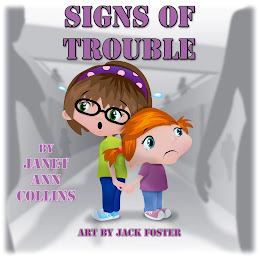
Now I've written a book for children specifically about kids with learning disabilities and it has just been published. Signs of Trouble is about two girls with dyslexia who get separated from their Special Education class on a field trip and use what they've learned about safety rules and recognizing signs to get reunited with them.
The book was officially released several days ago and I'm waiting for my copies to arrive in the mail and for it to appear on Amazon, which should happen soon. The book will also be available at other online sites like Barnes and Noble and bookstores can get it through their distributors.
I'm hoping the educational material in the back of Signs of Trouble will help kids understand others who are different from themselves as well as reinforcing safety rules and beginning reading skills. And I think they'll enjoy the story, too.

Wednesday, February 24, 2010

Brain Connections

When I was a substitute teacher I noticed kids in special education classes often had siblings in gifted classes, and we know some geniuses also had learning disabilities. Einstein is a well known example. Obviously there's some sort of relationship between how their brains work.
I've wondered for years about how other neurological problems might be linked. Are personality disorders similar to learning disabilities? Might OCD (Obsessive Compulsive Disorder) be caused by a variation of whatever causes autism? What about Antisocial Personality Disorder and all the others?
According to Temple Grandin, autistic people tend to think in colors instead of words. I think in both and have no symptoms of autism so I'm not sure what Grandin says is necessarily true. But if it is, what does that mean for people with achromatopsia? Are rods and cones in the eyes connected or related to parts of the brain that operate differently in autistic people?
How is narcolepsy related to epilepsy in terms of neurological connections. And, do either or both of those conditions relate to learning disabilities, ADHD (Attention Deficit Hyperactivity Disorder) or mental illness?
Our brains are incredibly complex and I doubt that anyone has studied the possible relationships between all these things, but I'd sure like to understand more about how they work.

Saturday, February 6, 2010

Neurofeedback

Recently I've blogged about contraptions that help people with various disabilities and results of severe emotional stress. Here's something I've recently learned about that's relevant to both topics.
Neurofeedback, also known as EEG (electroencephalogram) feedback is a way to help people control the bioelectric functioning of their brains. No, it's nothing like electroshock therapy. No electricity goes into the brain. Instead the electric brain waves are picked up by sensors and displayed on a computer so the person experiencing the test can learn to control them.
Acording to the information I've seen about this process, it may be used to treat many conditions including PTSD, autism, learning disabilities, ADHD, depression, migraines, and addictions. Some of these are still being tested, but the results seem hopeful.
I'll see if I can find out more about it and share what I learn here in the future.

Wednesday, January 20, 2010

Teachers

I still have the sweater vest a grateful mother made for me years ago because I'd "solved" her son's "problem." But there wasn't really a problem at all. The boy had been expelled from a preschool and his mother told that he had Attention Deficit Hyperactivity Disorder but he was a perfectly ordinary kid and did fine in my class. The previous teacher obviously didn't know how to deal with energetic children.
More recently another boy I know left the expensive private school he'd been attending because the teacher said he had learning disabilities. He was functioning academically far below grade level, but that might have had something to do with the fact that the teacher blamed him for every problem in class and he was often punished for things he hadn't done. After one year in public school his academic levels were normal and he was a much happier kid.
On the other hand, I had two preschool students whom I suspected had learning disabilities. In one case the parents had the child tested and got him into an early intervention program so he did well in school later. The other parents were in denial about the problem and didn't have the child tested for years, by which time she had learned to think of herself as a failure.
Teachers are not medically trained and are not qualified to make a diagnosis but if a teacher suggests that a child may have a learning disability it can't hurt to have testing done. Better safe than sorry.

Saturday, December 12, 2009

Early Intervention

When kids have special needs early intervention really can

make a big difference.

In the past children who were born deaf in hearing families

often didn't get the opportunity to learn any language until their

brains were past the readiness age for doing that. As a

result they had limited communication skills.

Learning disabilities and other neurological problems

were often not diagnosed until kids were around seven years

old. If they'd been able to get the help they needed earlier they

would have been able to learn a lot more.

I remember a little boy in my preschool class whose behavior was unusual. Among other things, any time there

was a lot of noise he'd run wildly around the room. I

suggested to his parents that they get him tested, which the local school district did for free.

He was found to have auditory processing disorder and the

school district provided the training he needed. As a result

he was able to function normally by the time he entered Kindergarten.

On the other hand, a little girl in my preschool was

advanced in some areas but had a lot of difficulty in others.

I suggested to her parents that they have her tested,

but they refused, insisting she didn't have a problem. She

later turned out to have a learning disability and was placed

in a Special Education class.

If only she had started getting the help she needed at an

earlier age perhaps she would have been able to attend

regular classes with only a few hours of tutoring by a

Special Ed teacher each week.

Any time there's even a slight chance that children

might have a problem it can't hurt, and might help a lot,

to have them tested as early as possible.

Wednesday, August 19, 2009

Learning Disabilities

I believe the politically correct term for Learning Disability is now Learning Difference - at least this week. Those terms for special needs keep changing because the conditions themselves are considered shameful, but I'll keep using the old one since I don't think there's anything to be ashamed of in having a disability.
Anyway, back when I was raising two kids with learning disabilities and working with kids in schools who had them I always wondered what they felt like. Then I found out.
As I mentioned a couple of posts ago, I used an anti-viral medication that caused neurological damage. While math was always one of my worst subjects in school (second only to handwriting) my aptitude test scores were above average in that subject and my reading and language scores were at the 99th percentile.
I haven't been retested since using that medication, but scores in both areas will certainly have gone down. I can still read well, but now I must make an effort to concentrate on things like academic texts if there is background noise, and it has become extremely difficult for me to remember numbers or do simple arithmetic. (Thank Heaven for calculators!)
So now I know what it feels like to have a learning disability and, you know what? It doesn't feel like anything. Being unable to think of a number or figure out a math question is no different from forgetting or not understanding something else. Everyone experiences things like that at times.

Wednesday, June 24, 2009

More on Teaching

     While I was a substitute teacher I would usually teach six-week summer school classes of kids with special needs. 
     One morning I read a book about a girl who wished she could be her wealthy friend to my class of kids with learning disabilities. Then I went around the circle and asked each student, "If you could be anyone you wanted, who would you be?"  
Since the students were mostly boys, the majority of them said they wished they could be their favorite super heroes, which wasn't surprising. 
     The boy at the end of the row had Cerebral Palsy so he used a wheelchair and had great difficulty using his hands and speaking. When it was his turn to answer my question he managed to get out the words, "I... like ... to... be... me."
     It happened that his family went to the same church I did, so I knew they were loving and supportive, and had obviously taught him what was really important in life.
     That was years ago, but sometimes even now when I have problems and start wishing my life were different or that I were capable of things I can't do, remembering that boy's words helps me appreciate what I do have.